I Borrowed a Chessnut Evo From a Friend — Here's the Truth About It
By PawnMasters Admin | April 20, 2026
How I Got My Hands on the Chessnut Evo
A friend of mine — a casual but enthusiastic chess player — picked up the Chessnut Evo AI Chess Computer a few months ago. When I saw it at his place, I immediately started grilling him about it. Eventually he handed it over and said: "Just take it for two weeks and tell me what you think."
So I did. I used it daily — played against the AI, connected it to Chess.com, tested the piece recognition, and put the LED system through its paces. This is not a spec-sheet review. This is what it's actually like to use the Chessnut Evo as your daily chess board.
First Impressions: Unboxing and Build Quality

The moment you open the box, the Chessnut Evo makes a statement. The board itself is solid — noticeably heavier than budget smart boards — and the surface has a premium matte finish that feels genuinely good under your hands. The squares are well-sized and the LED lights beneath them are bright without being garish.
The pieces deserve special mention. They are weighted, felted at the bottom, and have a satisfying click when you place them on the board. For a smart board at this price point, the physical quality is impressive. This doesn't feel like a toy.
The Star Feature: Full Piece Recognition

Most smart chess boards use a simple "lift and place" detection — the board knows a piece moved but doesn't always know which piece it is. The Chessnut Evo uses full piece recognition, meaning every single piece has a unique identifier and the board always knows exactly what's on every square.
In practice, this is a game-changer. You can set up any position mid-game — just drop pieces wherever you want — and the board tracks it correctly. You can knock over pieces by accident and the board still knows what's where. This sounds like a small thing until you've used a board without it and watched it completely lose track of a position after one misplaced rook.
The Maia Engine: An AI That Actually Plays Like a Human

This is where the Chessnut Evo genuinely stands out from every other smart board I've tested. Most electronic chess boards use Stockfish or a scaled-down version of it. Stockfish is the world's strongest open-source engine — but it doesn't play like a human. Even at low difficulty settings, it makes inhuman defensive moves and rarely blunders the way real opponents do.
Maia is different. Maia is an AI trained on millions of real human chess games. It was designed by researchers to predict what a human player at a specific rating level would actually play — mistakes and all. Playing against Maia at 1200 ELO feels like playing against a real 1200 player. It hangs pieces occasionally. It misses tactics sometimes. It plays human openings. For anyone under 1600, this is the most realistic and educational sparring partner you can get.
Online Play: Chess.com and Lichess on the Physical Board

Connecting the Chessnut Evo to Chess.com and Lichess via the companion app is straightforward. Once paired, every move you make on the physical board is registered online in real time — and your opponent's moves light up on the board via the LED system. You're playing a real online game with a real physical board. No lag, no sync issues in my testing.
This feature alone justifies a significant chunk of the price. The experience of playing rated online games on a real chess board instead of a screen is genuinely addictive. I found myself playing more chess in those two weeks than I had in months.
The LED Guidance System in Practice

The LED system is clean and intuitive. When it's your turn, your legal moves light up. Blunders are flagged. After a game, you can review move by move and watch the board replay the whole thing with light indicators. The colors are distinct enough to be immediately readable — I never found myself confused about what the board was telling me.
Compared to boards I've tested that only light up the "from" square, the Chessnut Evo's full move suggestion display is in a different league. It's especially valuable for beginners who are still building pattern recognition — the board essentially acts as a patient, always-available coach.
The Customizable Chess Bot: A Surprisingly Deep Feature

Beyond Maia, the Chessnut Evo lets you customize your AI opponent in granular ways — adjusting playing style, aggressiveness, opening repertoire tendencies, and blunder frequency. You can essentially build a bot that mimics a specific type of player you want to practice against. Want to practice against someone who always plays aggressively in the opening? Build that bot. Want to simulate your friend who always plays the Sicilian? You can get very close.
This level of customization is rare in standalone chess computers, and it gives the Chessnut Evo a long shelf life. You're not just buying a board — you're buying an opponent that grows and adapts with you.
What I Didn't Love
No review should be all sunshine, so here's the real talk after two weeks of daily use.
- ⚠️ The App Has a Learning Curve: The companion app is powerful but not immediately intuitive. It took me about 30 minutes of exploration to feel comfortable with all the settings. For non-tech-savvy users, this could be frustrating. That said, once you get it, you get it.
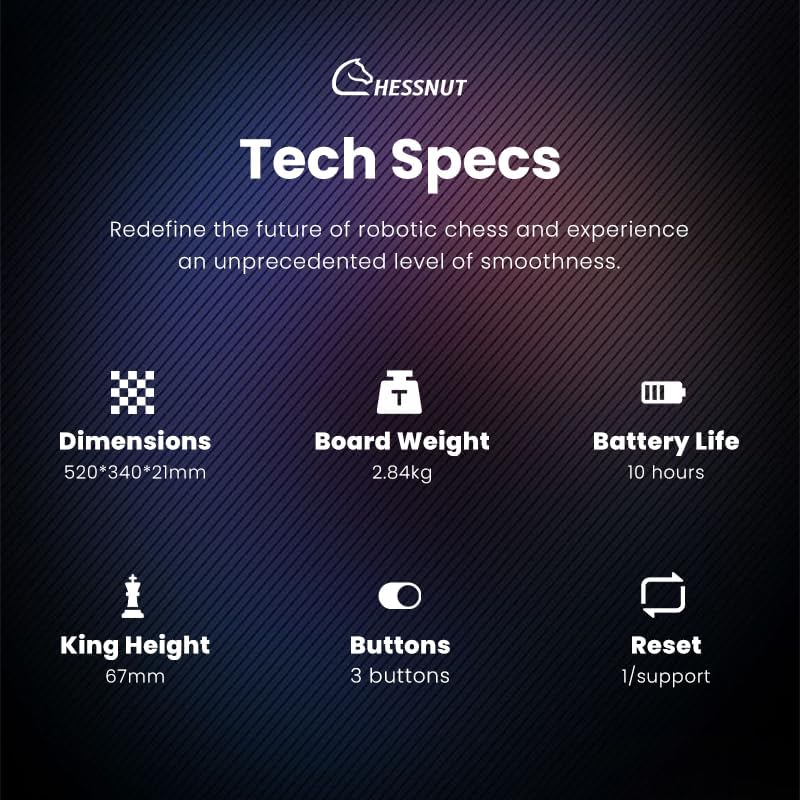
- ⚠️ Battery Life Is Adequate, Not Impressive: With Bluetooth active and LEDs running at full brightness, expect to charge every few days with regular use. Not a dealbreaker, but worth knowing if you travel with it.
- ⚠️ Price Premium: The Chessnut Evo is not cheap. You are paying for the full piece recognition and the Maia engine specifically. If those two features don't matter to you, there are more affordable smart boards that will serve you just as well.
- ⚠️ Pieces Are Not Dishwasher Safe (Obviously): Minor, but the white pieces do show fingerprints more than I'd like over extended use. A quick wipe fixes it, but it's worth noting for aesthetics-conscious buyers.
Head-to-Head: Chessnut Evo vs. The Competition
| Feature | Chessnut Evo | ChessUp ($399) | GoChess Mini ($249) |
|---|---|---|---|
| Full Piece Recognition | ✅ Yes | ❌ No | ❌ No |
| Human-Like AI (Maia) | ✅ Yes | ❌ Stockfish only | ❌ Stockfish only |
| Online Play (Chess.com) | ✅ Yes | ✅ Yes | ✅ Yes |
| Customizable Bot | ✅ Yes | ❌ No | ❌ No |
| LED Move Guidance | ✅ Full board | ✅ Full board | ✅ Color-coded |
| Build Quality | ⭐⭐⭐⭐⭐ | ⭐⭐⭐⭐ | ⭐⭐⭐⭐ |
The Final Verdict: Should You Buy the Chessnut Evo?
After two weeks with my friend's Chessnut Evo, I gave it back — and immediately started thinking about getting my own. That's probably the most honest endorsement I can give.
The full piece recognition and the Maia AI engine are not gimmicks. They are genuinely meaningful innovations that change how you interact with a smart chess board. Piece recognition makes the board feel reliable in a way that other boards simply don't. And Maia makes solo practice actually feel like practice against a real opponent — which is the whole point.
If you're serious about improving at chess and want a board that will serve you for years — not just months — the Chessnut Evo is the smartest investment on the market right now. I borrowed it. I'm buying one.

📚 Pair It With a Great Book: If you pick up the Chessnut Evo, combine it with Levy Rozman's "How to Win at Chess" for a complete learning system. Use the book to understand the principles, then drill them in real time on the board. The combination is unbeatable for players under 1400.